
Fixed vs Variable vs Split: Home Loan Choices in Today’s Market
Important notice:
The Markon Group does not provide financial advice. Any information in this article is general in nature only, shared “in passing” for educational purposes. It should be considered a first step only in your understanding. Before making any decision, seek professional advice from a suitably qualified person, such as a mortgage broker or an Australian-recognised financial institution.
Picking a home loan today isn’t just about chasing the lowest rate.
It’s about choosing a structure that matches your risk comfort, your cash flow, and your goals – especially if you’re planning a new build or a major renovation in QLD.
For many homeowners, the choice comes down to three main options:
- Fixed rate home loan
- Variable rate home loan
- Split loan (a mix of fixed and variable)
Let’s walk through what each really means in practice, how offset/redraw features and construction loan quirks come into play, and where each structure might fit in your journey.
1. Fixed Rate Home Loans: Certainty in an Uncertain Market
A fixed rate home loan locks in your interest rate for a set period (often 1–5 years). Your repayments stay the same during that period, regardless of what the market does.
When a fixed rate might appeal
- You want certainty over your repayments.
- You’re stretching slightly for your home and want to manage budget risk.
- You think interest rates may rise and want to protect yourself.
Common pros and cons of fixed rates
Pros (Fixed Rate)
- Repayment certainty: You know exactly what is coming out of your account every month.
- Protection from rate rises: If the RBA increases rates and lenders follow, your fixed rate doesn’t change during the fixed period.
- Can help with household budgeting, especially for families or single-income households.
Cons (Fixed Rate)
- Less flexibility:
- Often limited extra repayments.
- Break costs may apply if you refinance, sell, or switch during the fixed term.
- Offset accounts may be restricted or unavailable:
- Some lenders don’t offer an offset account on a fully fixed loan, or it might only be partial.
- If rates fall, you’re stuck at the higher fixed rate unless you pay break costs.
2. Variable Rate Home Loans: Flexibility and Features
A variable rate home loan moves with the market. Your interest rate (and repayments) can go up or down over time.
When a variable rate might appeal
- You want flexibility – to pay extra, refinance, or restructure without heavy penalties.
- You like the idea of using tools like an offset account or redraw facility.
- You’re comfortable that repayments may change and can handle some risk.
Key pros and cons of variable rates
Pros (Variable Rate)
- Flexibility:
- Usually easier to make unlimited additional repayments.
- Often easier and cheaper to refinance or restructure.
- Offset account compatibility:
- Many variable loans offer a full offset account, which can be powerful for managing interest.
- If rates fall, your repayments may reduce (depending on your lender).
Cons (Variable Rate)
- Repayment uncertainty: Rates can rise, and your repayments can increase.
- Emotional/psychological stress when markets are volatile.
- Budgeting can be trickier if you’re on a tight cash flow.
3. Split Loans: A “Best of Both” Approach
A split loan lets you divide your home loan into two parts:
- One fixed portion
- One variable portion
For example, if you borrow $600,000, you might fix $400,000 and leave $200,000 variable.
Why some homeowners in QLD like splits
- You lock in some certainty (fixed side) and keep some flexibility (variable side).
- You can pair a variable split with an offset account to reduce interest while still having part of your loan safely fixed.
- It can suit people who say, “I don’t want to gamble everything, but I don’t want to be completely locked in either.”
Pros and cons of split loans
Pros (Split Loan)
- Balance of risk: You’re not fully exposed to rate rises, but not fully locked in either.
- You can still use offset/redraw on the variable side (subject to lender terms).
- Can be tailored to your situation – e.g. 70% fixed / 30% variable, or vice versa.
Cons (Split Loan)
- Slightly more complex to manage – two portions, two sets of rules.
- The fixed portion still has break costs and limits on extra repayments.
- If you want to move lender later, both portions need to be considered – which can affect timing and costs.
4. Offset Accounts vs Redraw: Everyday Tools That Matter
The structure of your loan is one thing, but the features can make a huge difference to how you use your money.
Offset account (often popular in Brisbane & Gold Coast)
An offset account is a transaction account linked to your home loan. The money in that account is “offset” daily against your loan balance when interest is calculated.
For example:
- Loan: $600,000
- Offset balance: $50,000
- You’re effectively charged interest on $550,000 (simplified example).
Common points about offset accounts (general in nature):
- Great for people who like to keep savings accessible while still reducing interest.
- Often found on variable loans, though some lenders may offer them on certain fixed/split products.
- Particularly attractive in markets like the Gold Coast, where people may receive lump sums (e.g. bonuses, irregular income, rental income) and want to park funds strategically.
Redraw facility
A redraw facility lets you access any extra repayments you’ve made on your loan, above the minimum required.
For example:
- Minimum repayment: $3,000/month
- You pay: $3,500/month for a year
- The extra $500 x 12 = $6,000 may be available for redraw (subject to lender terms).
Offset vs redraw – practical differences (general concepts only):
- Offset:
- Separate account (often with a card).
- Money is typically 100% accessible, operating like a normal transaction account (subject to product conditions).
- Redraw:
- Funds are usually accessed via the loan account.
- Some lenders have limits, delays, or minimum redraw amounts.
Why this matters for structure
- If you value flexibility and cash-on-hand, a variable loan with an offset account can be attractive.
- If you’re mainly focused on paying the loan down faster and less on daily access, a redraw facility might be enough.
- For a split loan, you may often find the offset is attached to the variable portion, not the fixed.
5. Construction Loan Nuances: Building in QLD
If you’re planning to build a new home or undertake a major renovation in QLD, your finance structure might look a little different during the build.
Common construction loan features (general information only):
- Progress payments:
The lender generally releases funds in stages – slab, frame, lock up, fit out, completion – rather than all at once. - Interest-only during construction:
Many construction loans charge interest-only on the amount drawn during the build. Your repayments may be lower during this phase, then switch to principal + interest after completion. - Variable vs fixed during construction:
- Some people stay variable during construction for maximum flexibility.
- Once the build is complete, they may fix, stay variable, or split depending on their situation at the time.
How fixed, variable, and split play into a construction scenario
- All Variable during construction, then choose later
- You use a variable construction loan with an offset.
- You park your savings or contingency funds in the offset account while progress payments roll out.
- Once the home is complete and the final loan amount is known, you might:
- Fix some of the balance
- Keep it all variable
- Or set up a split loan.
- Split from the start (where allowed)
- You might have one split set up for construction (variable) and another intended as fixed later.
- This can be more complex and highly lender-dependent, so it’s something to discuss with a broker or lender.
- Fixed too early risk
- If you fix before you know the final amount or timing, you may risk:
- Fixing an amount that doesn’t match your end position; or
- Being caught with a fixed structure that doesn’t suit you if construction timing changes.
- This is a key area where professional advice can be important.
Again, all of the above is general information only. Construction lending can be highly specific, and what’s right for one project in Brisbane or the Gold Coast may not suit another.
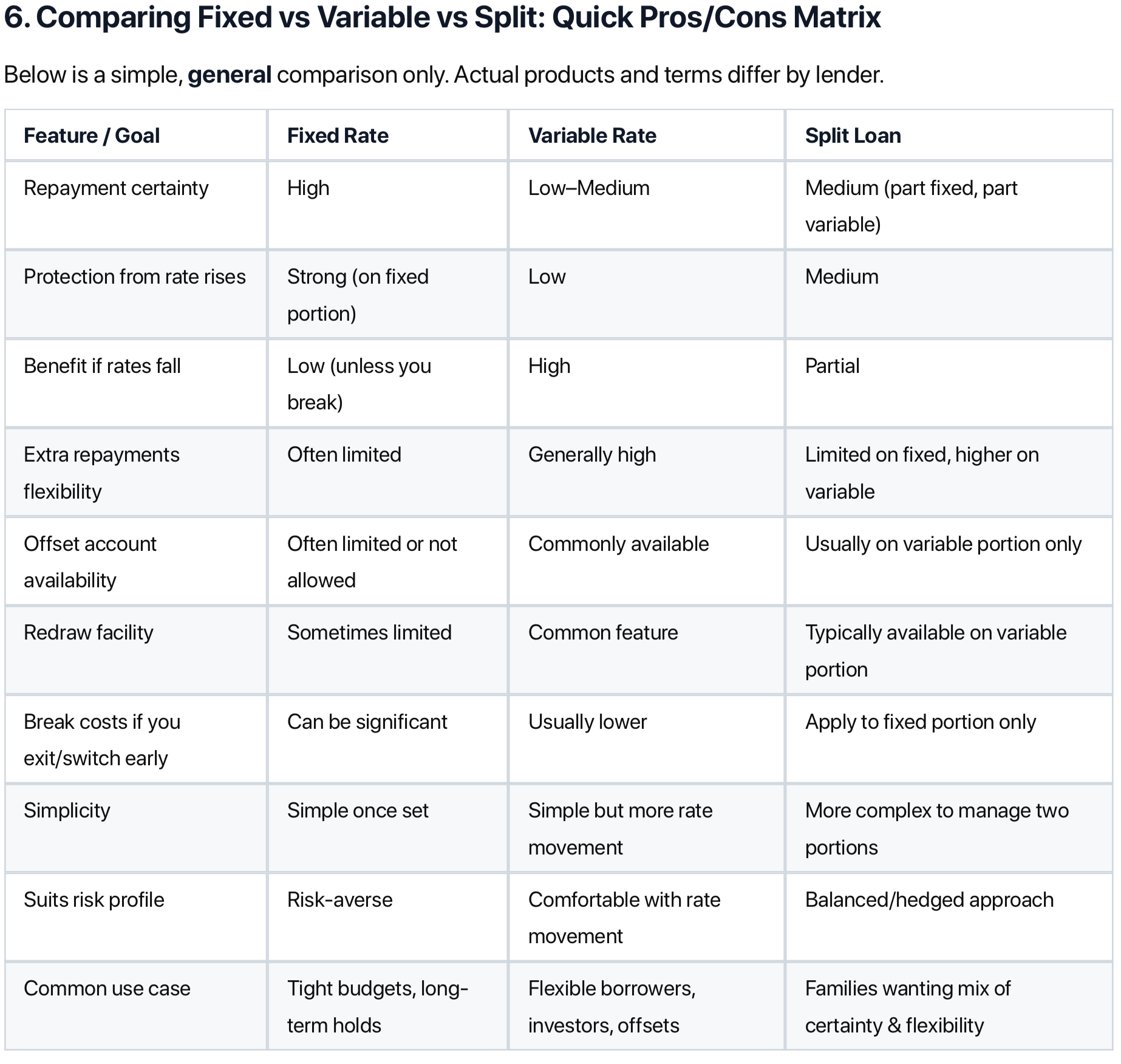
7. Scenario Snapshots (QLD-Focused)
These examples are simplified, general scenarios to help with awareness only. They are not personal advice.
Scenario 1: Young couple in Brisbane, planning a family
- Both working now, but one may step back from work in 2–3 years.
- Concerned about repayment shocks if rates rise.
- Wants some ability to put away extra savings now.
They might lean toward:
- A split loan – e.g. 60–70% fixed for stability, 30–40% variable with an offset account.
- This gives them:
- A stable base repayment; and
- A variable portion to put extra savings into, with access if needed.
Scenario 2: Gold Coast owner-occupier with fluctuating income
- Income includes commissions/bonuses.
- Wants to park lump sums to reduce interest but still access funds for opportunities or renovations.
They might consider:
- A variable rate loan with a full offset account.
- They treat the offset as their main account: salary, bonus, and savings sitting there, cutting interest while staying accessible.
Scenario 3: Brisbane family planning a construction project
- Have land or are about to buy.
- Need a construction loan for a new build.
- Expect building to take 12–18 months.
They might:
- Use a variable construction loan during the build with an offset for their cash buffer.
- After completion, review their position and possibly move to:
- A fixed rate,
- Stay variable, or
- Set up a split to balance certainty and flexibility.
Again, these are just illustrative examples, not recommendations.
8. How to Start Thinking About Your Own Structure
When you’re weighing up fixed vs variable vs split home loan options in QLD, it can help to ask yourself:
- How important is repayment certainty to me?
- How comfortable am I with rates (and repayments) moving up and down?
- Do I need daily access to savings (via an offset), or am I happy to lock extra money into the loan?
- Am I looking at a straight purchase, or is there a construction/renovation element?
- How likely is it that I’ll refinance, sell, or restructure in the next few years?
The answers to these questions can guide a conversation with a mortgage broker or lender who understands the local Brisbane, Gold Coast, and wider QLD market.
9. Final Reminder: General Information Only
To reiterate:
- The Markon Group does not give financial advice.
- Everything above is general information only, intended to help you understand concepts like fixed vs variable, split loans, offset accounts, redraw, and construction loan considerations.
- Your circumstances are unique. Interest rates, lending policies, and product features change over time.
Before you choose a structure or commit to a lender, you should seek professional financial advice from a suitably qualified person, such as a mortgage broker or an Australian-recognised financial institution.
Next Step: Map Your Finance-Ready Build with Homes by Markon
If you’re thinking about building and want to understand how your finance journey lines up with your build journey, the next step is to map out the finance-ready build steps with Homes by Markon.
We can help you:
- Clarify the stages of your build.
- Understand where finance milestones typically sit along that journey.
- Prepare better questions to take to your broker or lender.
Map your finance-ready build steps with Homes by Markon and take the first, informed step towards a home that’s designed – and financed – to fit your life.
Contact The Markon Group today:
📍 Location: 20–24 Commerce Drive, Browns Plains, Brisbane
📞 Phone: +61 7 3153 2000
🌐 Website: www.markongroup.com.au
✉️ Email: info@homesbymarkon.com.au
Building futures for Queensland families.